Santiago to Valparaíso: how to get there and what to see in a day
Valparaíso is 120 km northwest of Santiago and easily doable as a day trip: leave the capital in the morning, spend six hours in the port, and be back in Santiago for dinner. The question isn’t whether to go — most first-time visitors to Chile end up in Valparaíso — it’s how to go and what to see once you’re there. This guide answers both.
How to get from Santiago to Valparaíso
Three main options, ranked by convenience:
1. By private car with driver-guide (fastest, most flexible)
Door-to-door from your Santiago hotel to Valparaíso and back. Takes 90 minutes each way via Ruta 68. You control the departure time, the stops on the way (Casablanca Valley wineries, coastal viewpoints), and the return schedule. If your Spanish is limited and you want context in English, this is the option most first-time visitors choose. Cost is USD 380-560 for a group of up to 8, all-inclusive. See our Valparaíso and Viña del Mar private tour.
2. By intercity bus (cheapest, most self-directed)
Buses leave from Santiago’s Terminal Alameda (also called Terminal Estación Central) every 15 minutes with the companies Turbus, Pullman and Condor Bus. Trip takes 1h45 to 2h00 depending on traffic. Fare is CLP 5.000 to 8.000 (USD 5-9) each way. Book same-day at the terminal or online via pasajebus.com or the company websites. Buses arrive at Terminal Rodoviario in Valparaíso, 8 minutes by taxi from the port and 15 minutes on foot from the funicular circuit.
3. By ride-share (Uber/Cabify) or taxi
Uber and Cabify work reliably in Santiago and both cover the Santiago–Valparaíso route. Cost is CLP 45.000 to 65.000 each way (USD 50-70) depending on demand. Practical only if you’re travelling in a group of 3-4 people who can split the cost.
A note on the train: there’s no working intercity train between Santiago and Valparaíso as of 2026, despite periodic announcements. The Metro Regional Merval runs only between Viña del Mar and Valparaíso, once you arrive.
When to go
- Best months: October to April, when the coastal weather is warm and dry. Sunsets over the Pacific are worth staying for.
- Avoid if possible: January and February — Chilean summer holidays crowd the city and every restaurant needs reservation.
- Off-season charm: May to September brings fog and light rain, but the hills with mist have a distinct atmosphere and the crowds vanish.
- Best day of the week: Tuesday to Friday. Weekends bring domestic tourism from Santiago; Mondays some museums close.
What to see once you’re there
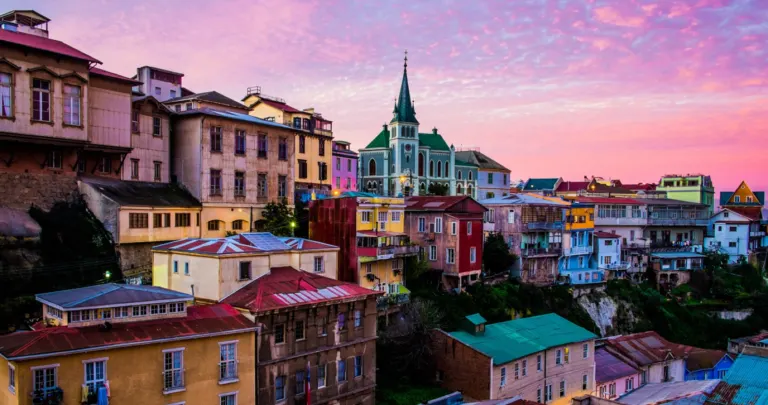
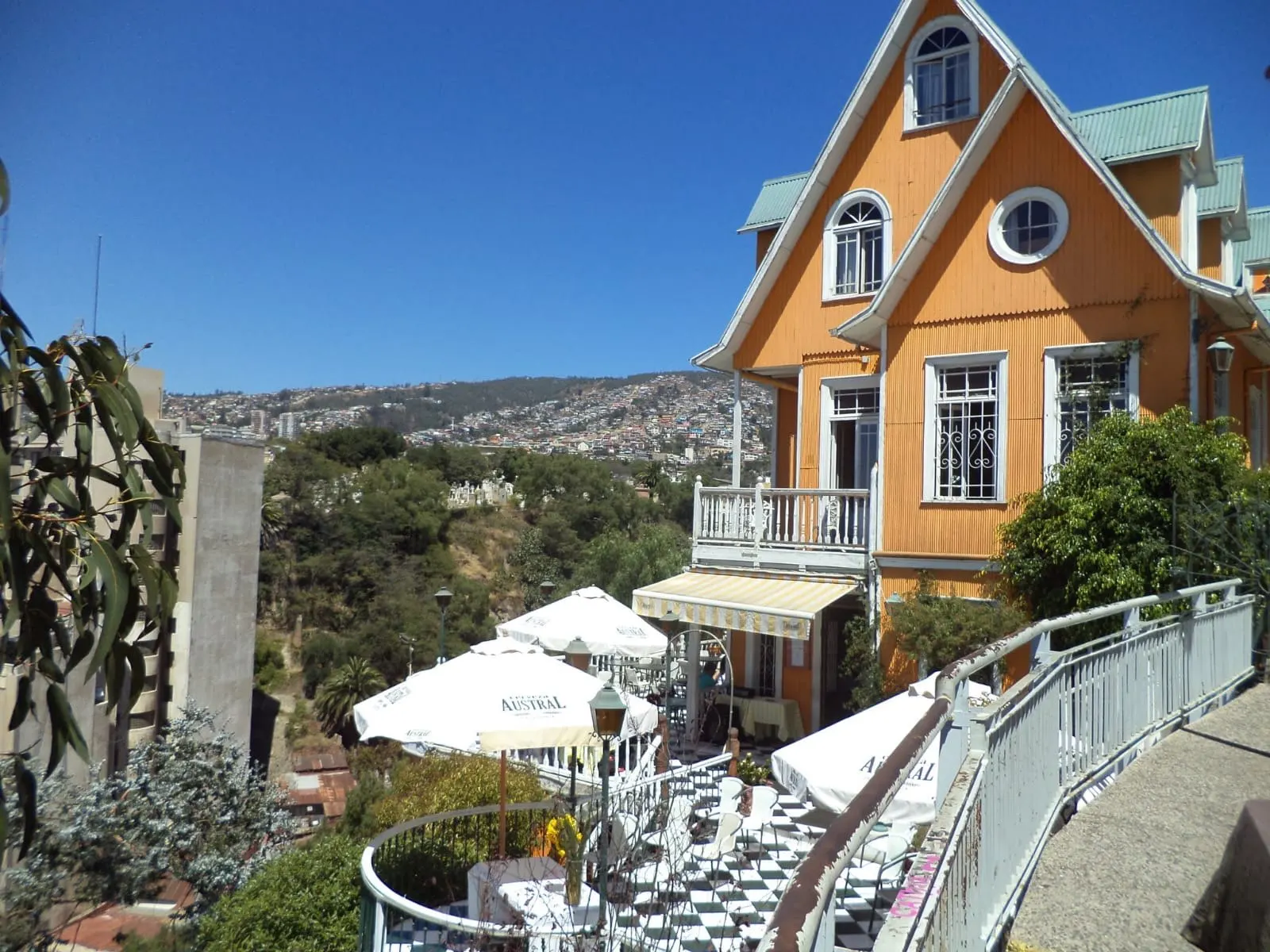
Valparaíso is a working port city built onto forty-two hills. The historic heart is Cerro Alegre and Cerro Concepción: UNESCO-listed hills covered in nineteenth-century wooden houses, painted in ocean colours, connected to the port below by century-old funiculars called ascensores. Everything else radiates from those two hills.
The essential half-day loop
- Plaza Sotomayor. The lower gateway, next to the ex-Navy palace and the underground archaeological museum. 20 minutes.
- Ascensor El Peral (1902). A century-old funicular. Cost: CLP 500 (USD 0.55). Drops you at Paseo Yugoslavo, the entrance to Cerro Alegre.
- Paseo Yugoslavo → Paseo Atkinson → Paseo Gervasoni. The classic viewpoint sequence. Painted houses on your left, the port on your right. 45 minutes with photo stops.
- Cross to Cerro Concepción by walking down Templeman Street and up Bavestrello Passage. The staircases here are among the most photographed corners of the city.
- Ascensor Concepción (1883). The oldest funicular in Chile. Costs the same as any other. Returns you to Calle Prat in the port.
Beyond the two main hills
- La Sebastiana — Pablo Neruda’s Valparaíso home in Cerro Florida. The most personal of Neruda’s three houses. Admission CLP 9.000. Read our Isla Negra + Neruda tour if you have more than a day and want to visit his other properties.
- Museo a Cielo Abierto. Open-air murals by major Chilean artists (Roberto Matta among them), curated in the 1990s on Cerro Bellavista. 40-minute self-guided walk.
- Ascensor Artillería. The best panoramic viewpoint over the port. Combines beautifully with sunset if you can time it.
- Mercado Cardonal. The traditional market — nothing gastro-touristy, just fishmongers, butchers and upstairs the cocinerías where the locals actually eat lunch for CLP 6.000.
- Muelle Prat. Short boat tours around the harbour depart from here — 30 minutes, CLP 8.000 (USD 9). Best for close-up views of docked cruise ships and cargo vessels.
What to add if you have a full day (10-12 hours)
If you leave Santiago at 07:30 you can add either of these to Valparaíso in the same day without rushing:
- Viña del Mar — 10 minutes by taxi or Metro Merval north of Valparaíso. The Flower Clock (Reloj de Flores), coastal boulevard, and beaches. Best combined as Valparaíso 09:30–14:00, Viña del Mar 14:30–17:00, drive back to Santiago 17:00. Our Valparaíso + Viña del Mar city tour covers both in a single day.
- Casablanca Valley wineries — 30 minutes east of Valparaíso, on the Ruta 68 back toward Santiago. Two boutique wineries with tasting fit comfortably between Valparaíso and Santiago on the return. See our Casablanca wine tour.
- Isla Negra — 75 minutes south of Valparaíso by coastal road. Pablo Neruda’s ocean-front home is the most famous of his three houses. Not ideal for a same-day return if Valparaíso is your first stop — it deserves its own half-day.
Practical tips first-timers wish they had known
- Bring cash for the funiculars. Some accept the Bip! transit card, but coins in CLP 500 pieces are the fastest way to pay.
- Eat up in the hills, not on Plaza Sotomayor. The best restaurants are in Cerro Alegre and Cerro Concepción, not down by the port. Fauna, Norma’s, Espíritu Santo and Malandrino are the ones locals recommend.
- Weather turns fast. The coast can be sunny at 11:00 and foggy at 15:00. Bring layers, especially in autumn.
- The port area itself isn’t the main sight. The romance of Valparaíso is in the hills, not the docks. Don’t spend an hour looking at cargo cranes.
- Don’t drive yourself. Parking is scarce, streets are narrow and one-way, and the hills are practically un-driveable for anyone new. A driver-guide is not a luxury — it’s efficiency.
Frequently asked questions
How far is Valparaíso from Santiago exactly?
120 km via Ruta 68. Driving time is 90 minutes off-peak; add 30-45 minutes if you leave Santiago during morning rush hour (07:00-09:30) or return during evening rush (17:30-20:00).
Is one day enough for Valparaíso?
Yes for a first impression; not for anyone who wants to really know the city. In one day you can cover Plaza Sotomayor, Cerros Alegre and Concepción, one or two funiculars, La Sebastiana and a proper lunch. Adding Viña del Mar makes it a full day. Two days lets you slow down and add Isla Negra or Casablanca wineries.
Is Valparaíso safe for tourists?
Cerro Alegre and Cerro Concepción are safe by day and well-populated. Some lower neighbourhoods and the port perimeter warrant more caution at night. Standard urban precautions apply: watch your bag on public transport, don’t display valuables. Valparaíso is comparable to any mid-size Chilean city.
Do people speak English in Valparaíso?
Some — in the touristy hills, at restaurants and hotels, English is widely enough spoken to manage. Outside those areas, Spanish only. Basic Spanish phrases go a long way, and Google Translate covers what they don’t.
If you’re planning a Santiago-to-Valparaíso day trip and want it built around your interests, message us on WhatsApp — we’ll suggest the timing, the route (Ruta 68 vs coastal), and which hills to prioritise. Free consultation.